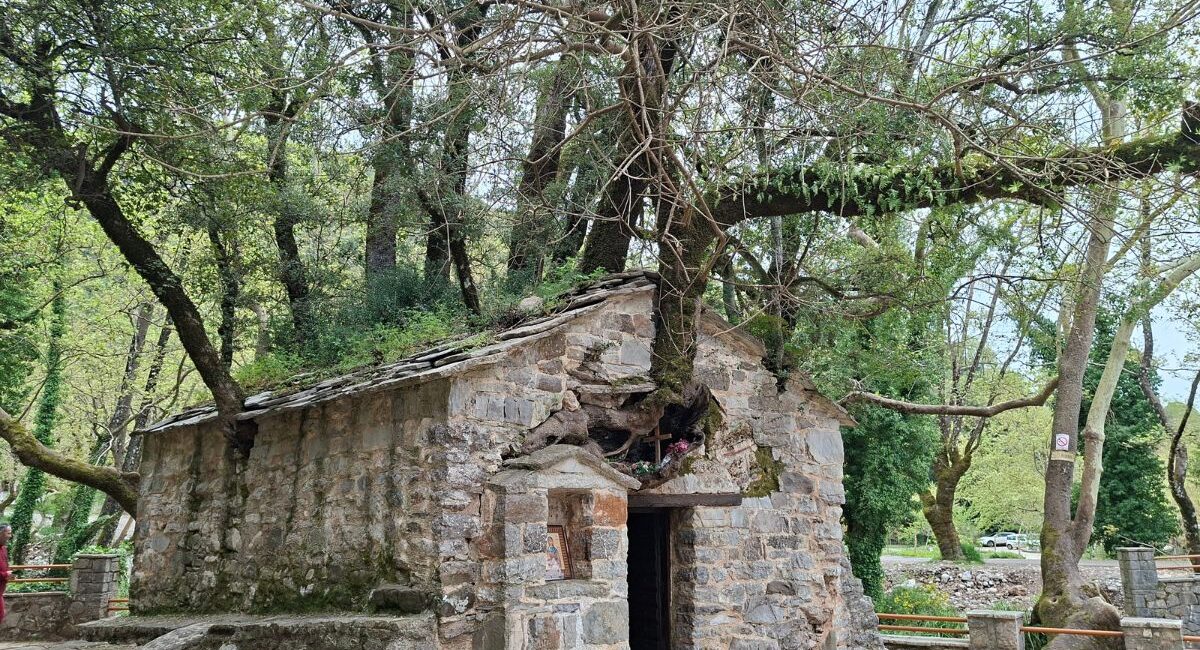
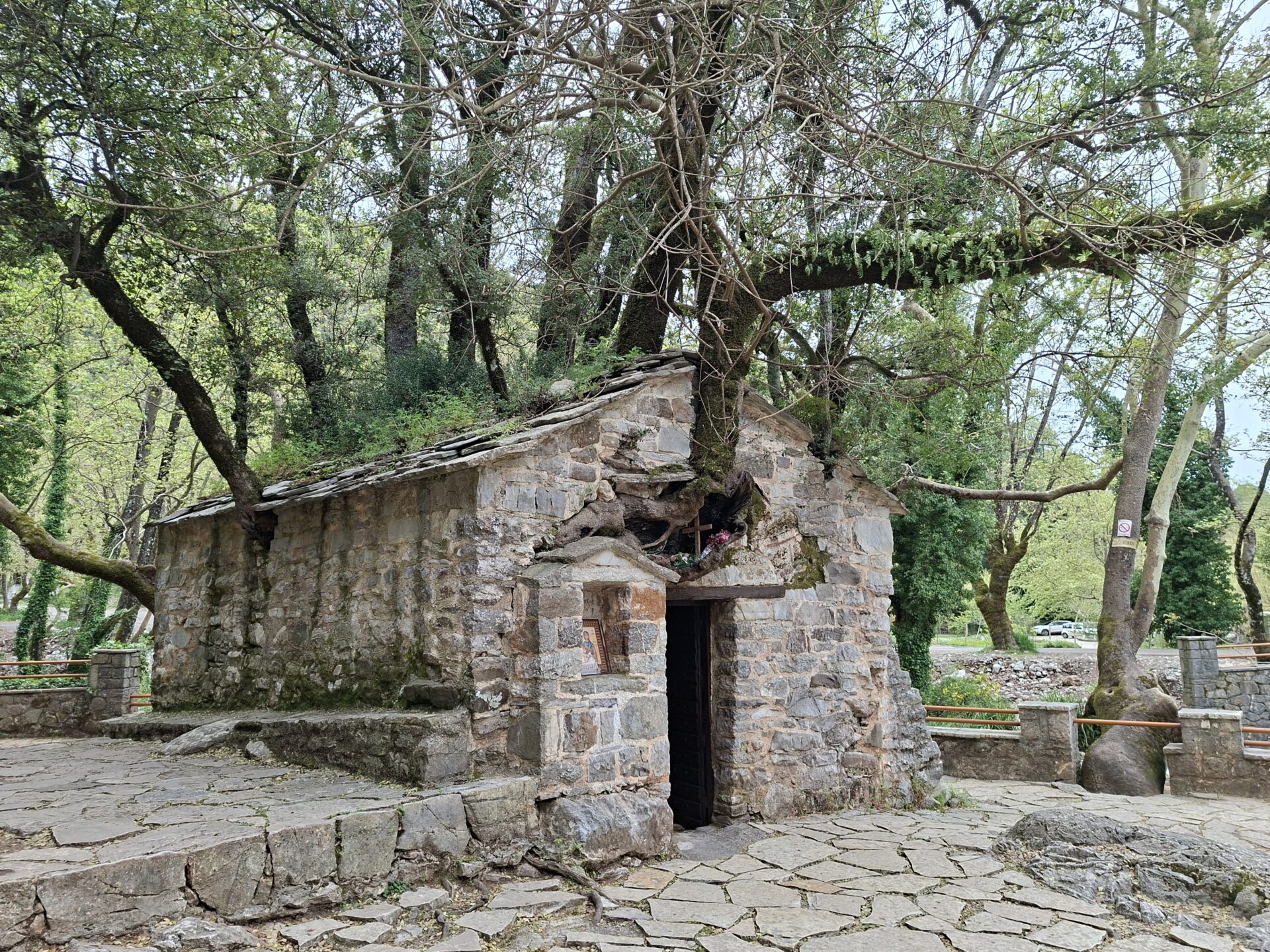
Count the trees on the roof. Most visitors get to seventeen before they stop trusting their own eyes: seventeen tall trees — some of them oaks and maples over ten metres high — growing straight out of the stone roof of a chapel barely bigger than a village kitchen. No soil to speak of. No visible roots in the walls, which are half a metre thin. And beneath the floor, a spring that never runs dry, hurrying out from under the altar as if it had somewhere to be.
This is Agia Theodora, hidden in a fold of the hills near the village of Vasta, south of Megalopolis — perhaps the strangest sacred place in the Peloponnese, and one of the least explicable buildings in Greece. Engineers have studied it. The roof should have collapsed generations ago under the weight of the trees. It hasn’t.
The girl who became a church
The legend is older than the 12th-century chapel itself. Theodora was a girl from Vasta in a time of raids, when every family owed a fighting man. Having no brother, she cut her hair, took a man’s name and went in her father’s place. Falsely accused of a crime only a man could commit, she chose death over revealing her secret — and prayed, as the story goes: let my body become a church, my hair the trees, my blood the water.
Stand inside for a moment — the chapel holds five, six people at most — and listen to the water running underneath. Whatever you believe, the place keeps its promise.
Make it a slow afternoon
Agia Theodora pairs naturally with the quiet side of central Arcadia: the ruins of ancient Megalopolis, the light on Mount Lykaion, an unhurried lunch in a village square. It asks nothing of you but low voices and a little time — this is a living place of prayer, not an attraction. Combine it with the cliff monasteries of the Lousios for a full day of Sacred Arcadia, moving the way the place has always been visited: slowly.
A landmark on the Arcadia Trail
Agia Theodora is not only a place to drive to. It is one of the landmarks of the Arcadia Trail, the waymarked route through south-western Arcadia that is part of the Peloponnese Trails network. On the Lykaion branch the path climbs from Karytaina to the summit of Mount Lykaion, then comes down through the woods to Vasta and Isaris — and the little chapel with the trees on its roof sits right on that stretch, a short walk from the village.
Arriving on foot is the best way to meet it. You come down off the mountain along old village paths, the same ones people, mules and flocks used for centuries, and the chapel appears between the trees as if it had grown there too. Plan a stop of at least half an hour, keep your voice low, and leave time to listen to the spring.
Travel idea: The Castle and the Old Line
If you would rather have the whole journey arranged, our four-day itinerary The Castle and the Old Line puts Agia Theodora at the heart of its second day. You sleep three nights in Leontari, so you never repack, and the days unfold by e-bike, on foot and on horseback: a ride beneath the Frankish castle of Karytaina, a hike through the stone-cut tunnels of the abandoned metre-gauge railway, and the ancient theatre of Megalopolis to finish.
Day 2 · Miracles & Mountain Villages. After a short morning transfer to Vasta, you walk to the chapel of Agia Theodora and hear the legend where it happened. From there the path continues through the landscape to the old Isaris railway station and into the village, before the transfer back to Leontari.